Two fantastic artists; each hold a separate style; both share a similar interest. The two artists go by Daim and Kurt Wenner. Kurt specializes in anamorphic illusionistic style while Daim prefers his graffiti.
Daim is a professional German graffiti artist. He started his career in 1989 and has forever since then, explored the limits of his mind. His style and technique makes you feel like you’re lifting from your body, entering his realm of imagination. This quote will give a better descriptive explanation of his work. “His geometric figures and letters obey the laws of light and shadow but defy gravity and curve space. The beholder is sucked into the image or feels transported to new dimensions”
-DAIM graffiti art.
 In a fairly recent post, I briefly mentioned Kurt’s connection to the modern anamorphic illusionistic style of art. After his venture to Italy, Kurt brought back the idea of 3D street art. He became America’s founder of this world historic treasure.Both Kurt and Daim share their interest in the three dimensional world. They grew from their hobbies as amateurs to world renowned professionals. Geometry plays a vital role in both art forms. Kurt’s use of geometry and classicism gives a distortion making viewable from a specific angle. Daim’s use of it doesn’t give off as much of a distortion as Kurt. The last comment could be considered a difference too because their use of geometry is different, yet a similarity because it is vital for both to use it.Their difference lies in the art forms themselves. The style of graffiti and street art in attraction and perception. Street art pulls a more realistic classicism and expresses its dimensions. Daim’s graffiti shoots for a more quick, fashionable appeal. If you look at graffiti at any angle, you can still see the dimensional jump from 2D to 3D. Street art relies on a perspective and only one viewpoint. If you were to draw a person on the ground in 3D, if you stand next it, all it is is a bunch colors added together. View it from the front, you can start to see the painting come alive.Although these people share their differences, they still connect in a way with a few similarities. Both art fanatics still scour the globe spreading their passion and talent among everyone else.
Sources:
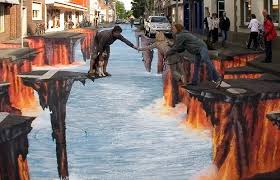 Street art; something that appeals to everybody. This art form has come as a great way for expression and a perfect portrayal of depth and dimension. I find this a my most favorite style; using the street and surroundings as your personal art gallery. Today’s post will discuss brief history of street art.
All that is Interesting says, “though the medium is widely regarded as a modern art, street art traces its origins back to the Renaissance.” Of everything I heard about this art form, I never heard about it’s origins in the Renaissance.
Kurt Wenner could be classified as today’s modern street art founder. The key words are could and modern. The reason I say this is because he was not the first person to start this style, for he was born until the 1900s. He traveled to Rome, Italy in 1982 to discover the madonnari unique form of art. After his return the U.S., he traveled to Santa Barbara Museum of Art to introduce his findings; thus, becoming the founder of the American style.
Mentioned before, “madonnari were italians that traveled between festivals that lived off of coins simply thrown to the side due to their visual talents.” They were the first founders of street art and they prospered in the time of the Renaissance. Madonnari wasn’t a family or person’s name, it was the title branded to a type of people based on occupation.
Kurt combined today’s modern style of street art with classical style painting to create his own form, now known as 3D street art. The original name of this style is called anamorphic illusionistic.
His painting and drawings have now become a sensation and discussed in at least a dozen different broadcasts, magazines, newspapers, and blogs since his return from Italy. Down below are two examples of Anamorphic Illusionistic style drawings.

Sources:
